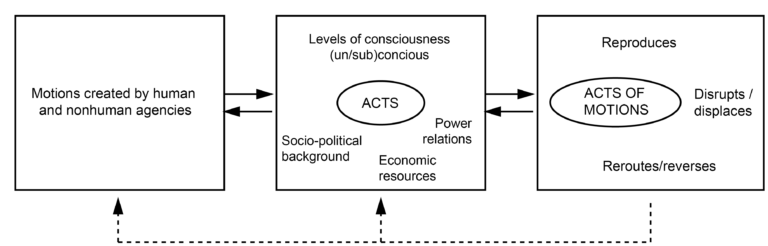
Jussi P. Laine and Md Azmeary Ferdoush challenge the longstanding assumption that borders are fundamentally human constructs. In a chapter published this month in an Oxford University Press edited volume, they introduce the concept of acts of motion: a framework that treats borders not as fixed lines but as dynamic outcomes of both human and nonhuman forces.
The authors argue that border scholarship has remained too focused on human agency, overlooking how climate change, viral outbreaks, and infrastructural collapse actively reshape where and how borders operate. By bringing together insights from the mobility turn and posthumanist theory, they show that motion — whether of people, pathogens, or sea levels — only becomes a border when humans interpret and institutionalize it within existing power structures.
The result is a framework that avoids both human exceptionalism and environmental determinism, recasting borders as relational assemblages that are continuously co-produced through recursive cycles of motion and act.
Available at Oxford Intersections: Borders https://doi.org/10.1093/9780198945222.003.0219