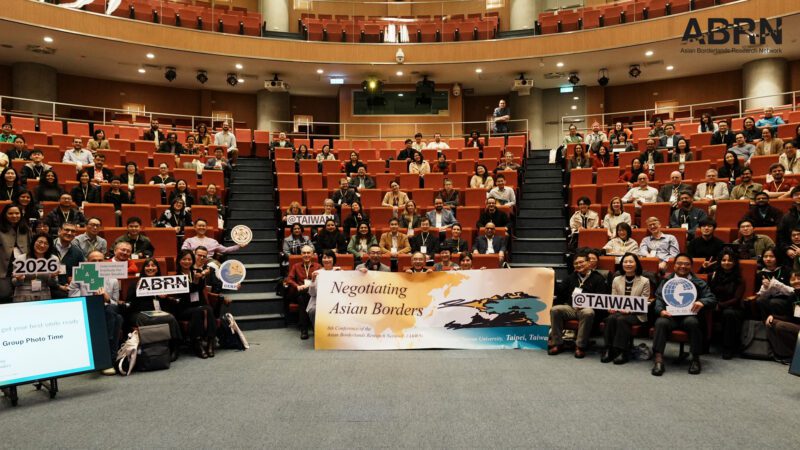
Photo by the 8th Asian Borderlands Research Network Conference Organising Team.
The PLACE TO BE for the scholars studying Asian borders – and beyond – is the Asian Borderlands Research Network (ABRN) biennial conference. The most recent one, in January 13-15, 2026, titled “Negotiating Asian Borders: Actors, Displacements, Multiplicities, Sovereignties,” attracted over 200 scholars and experts from 37 countries worldwide. The National Taiwan University (NTU), Taipei, hosted the event at its historic campus, expertly coordinated by its Department of Geography, Environmental and Resource Sciences.
During the three busy days on the NTU campus, the Eur-Asian Border Lab plunged into the whirlwind of debates and research questions raised by scholars, but also met colleagues and friends across the world during lunch and coffee breaks, and made new connections.
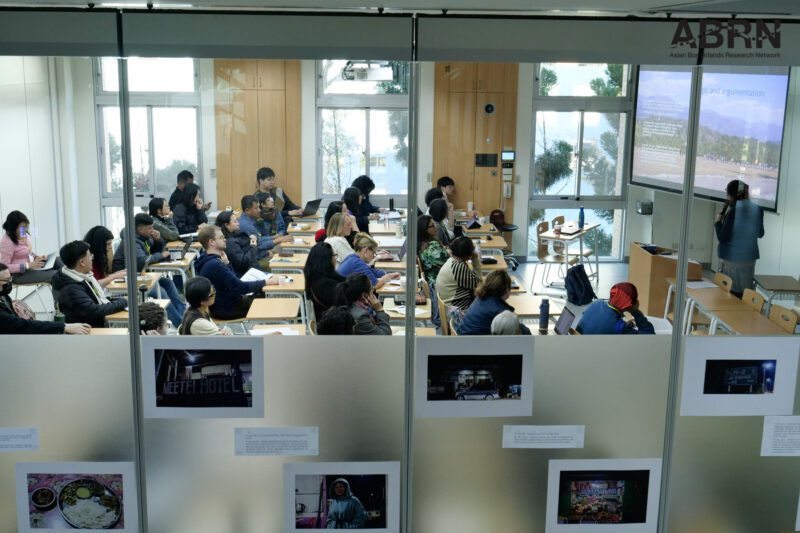
A panel session in full swing.
Photo by the 8th Asian Borderlands Research Network Conference Organising Team.
The conference ran 167 research presentations, two keynote speeches and dedicated film screenings over the three days. The scope of research was notably broad, moving beyond what has traditionally been treated as the triad of actors in the Asian borderlands – the state, military and local borderlanders. The research today includes the multiple non-humans, factors in indigenous voices or acknowledges algorithms in bordering. Thus, from exploring the agency of armyworms, microbes, yaks and spirits to discussing the role of data in shaping bordering, the discussions were deep and intense. Uniquely, most participants followed the call by the organizers to talk through – not read! – their usual 15-minute presentations. This added quality to the discussion sessions.
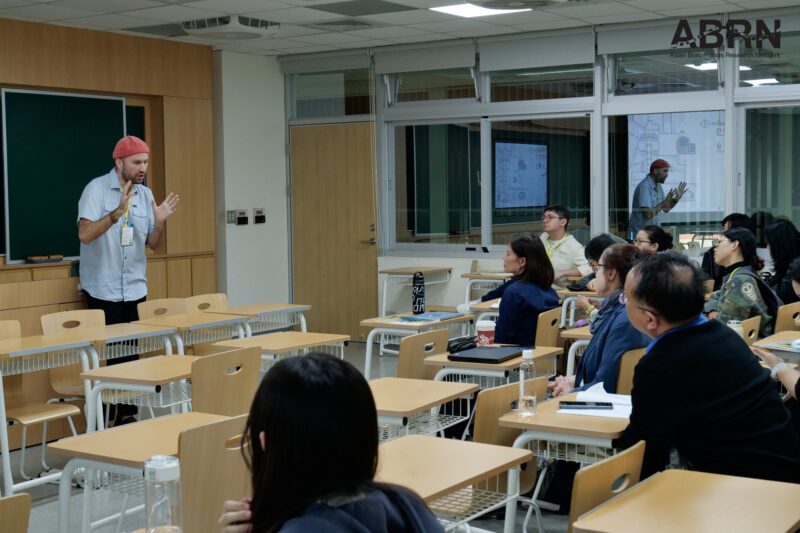
Laur Kiik (University of Oslo) talking about the Kachin amber and war in the panel “Contested Ecologies, and Borderland Sovereignties Tensions.”
Photo by the 8th Asian Borderlands Research Network Conference Organising Team.
The success of the ABRN conferences explicitly reflects the boom in Asian border studies. Its first conference in 2008 in Guwahati received 88 applications. The call for the third conference in Singapore (in 2012) yielded 210 applicants and proposals for 24 panels, while the 8th conference in Taipei had 400 applicants, among who around 200 were accepted, according to the organizers.
The boom in Asian border studies also reflects the ways how borders have become central to social science scrutiny of diverse themes – from the more common studies of identities, mobilities and developments at territories’ edges to topics around bordering and memory, bordering and bodies, to bordering islands, empires, air and seas. These are just some examples of the panel themes in Taipei.
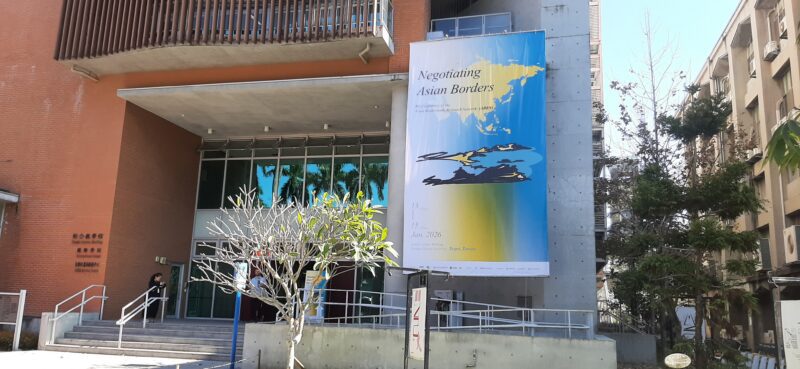
NTU campus and ABRN billboard.
Photo by K.Dean
Last but not least, in line also with the Eur-Asian Border Lab spirit of advancing transregional discussions amongst border scholars of Europe, Asia and beyond, the 8th ABRN conference went beyond discussing bordering solely in Asia. The audience also learned about embodied borders in Georgia and the frontline in Ukraine, and had a chance to engage with pioneering comparative research on border transformations between Finland and Taiwan. Tracing trans-regional threads opens up opportunities to expose even more nuances and mechanics of bordering.
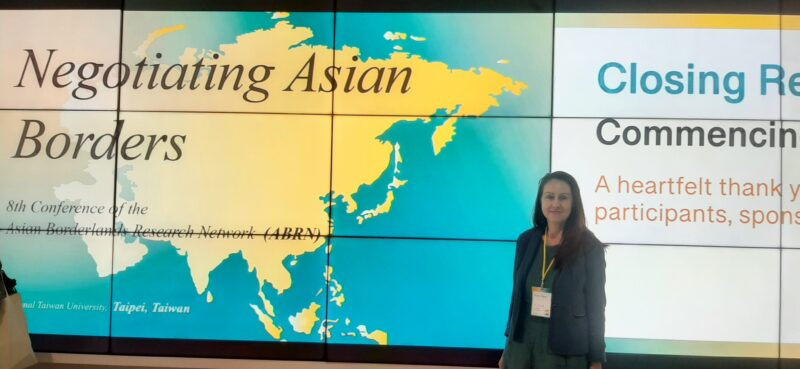
Karin Dean (Tallinn University) at National Taiwan University in front of the conference billboard.
Photo courtesy of a colleague
More info on the Asian Borderlands Research Network (ABRN) and its conferences:
https://www.iias.asia/programmes/asian-borderlands-research-network
ABRN 8th Conference, 13-15 January 2026 at National Taiwan University in Taipei, Taiwan:
“Negotiating Asian Borders: Actors, Displacements, Multiplicities, Sovereignties,”