
By Willem van Schendel
Rivers and river basins have their own histories that long predate Homo sapiens. But when humans appeared, rivers became crucial co-constituents of human social life. Rivers were no longer purely “natural” but began to be shaped by humans. Flowing water, sediments, animals, plants, micro-organisms, and human societies became permanently entangled. This connection is currently imagined as the “hydrosocial cycle … a socio-natural process by which water and society make and remake each other over space and time.” But rivers differ in how they shape human societies, just as humans differ in how they view and exploit rivers. By taking a single river as a springboard, you can expose an entire hydrosocial universe of “riparian relations.”
That is why focusing on cross-border rivers can help us understand the past and present of borderlands and the people who live there. Biographies of rivers are not uncommon, but they tend to tell the story of huge ones: the Nile, the Mississippi, the Rhine, or the Brahmaputra.
The Karnaphuli is a smallish river fed entirely by tropical monsoon rains. It flows from India into Bangladesh – as do at least 50 other rivers. It is some 270 km long and ends in Bangladesh’s prime seaport, Chittagong. On its way from its mountainous origins via plainlands to the sea it passes through four distinct environmental and cultural zones. The mountains, today located in India, and the foothills (across the internation border, in Bangladesh) are usually thought of as being part of “Southeast Asia,” while the plains and the urbanized seaboard (in Bangladesh) are in “South Asia.” The Karnaphuli also crosses the border of one of the world’s biodiversity hotspots: the mountain and foothill zones belong to “Indo-Burma,” while the plains provide an ecological contrast.
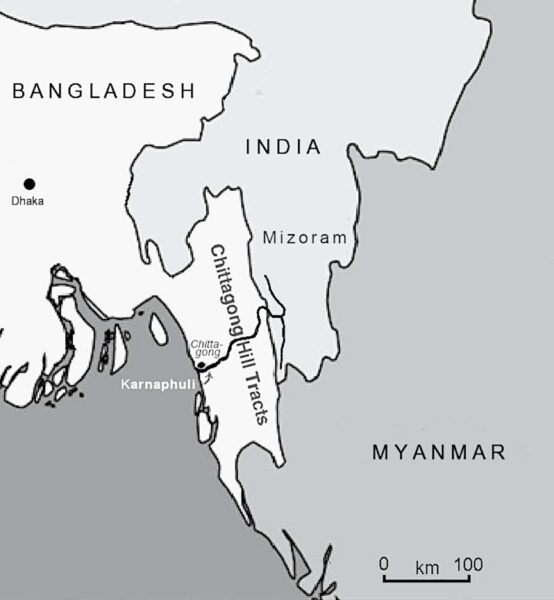
Figure 1. The Karnaphuli, a cross-border river.
Map: Willem van Schendel.
The river serves as an important trade route between these zones but, even so, over the centuries the cultural distinctions between them have been remarkably persistent. Religion is an example: the mountain people are largely Christians, the foothill people Buddhists, and the plains people Muslims and Hindus.
The idea of a fixed administrative border was a European innovation. As the British spread their empire across these lands, they created a provincial border across the Karnaphuli, and this turned into an international one – between India and East Pakistan (after 1971: Bangladesh) – when British imperial power in South Asia empire collapsed in 1947. Since then the border has been officially closed because relations between these neighbouring states fluctuated from tense to hostile.
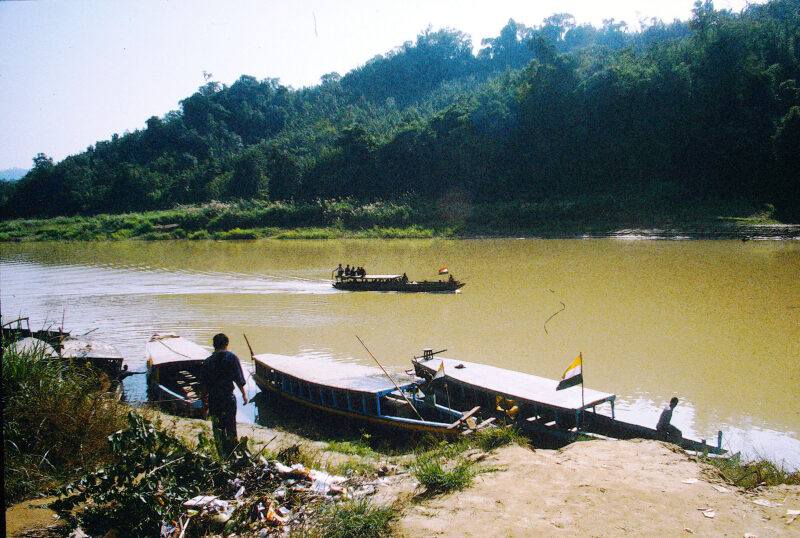
Figure 2. Boats with Indian flags on the Karnaphuli where it crosses into Bangladesh.
Photo: Willem van Schendel.
Human exploitation of the river included increasing ecological degradation (water pollution, overfishing) and the construction of a hydroelectric barrage across it in the 1960s. This dam created the huge Kaptai Lake, flooding about 40 per cent of the region’s agricultural land, destroying numerous villages and forests, and driving some 100,000 people to seek refuge. Many crossed the border into India.
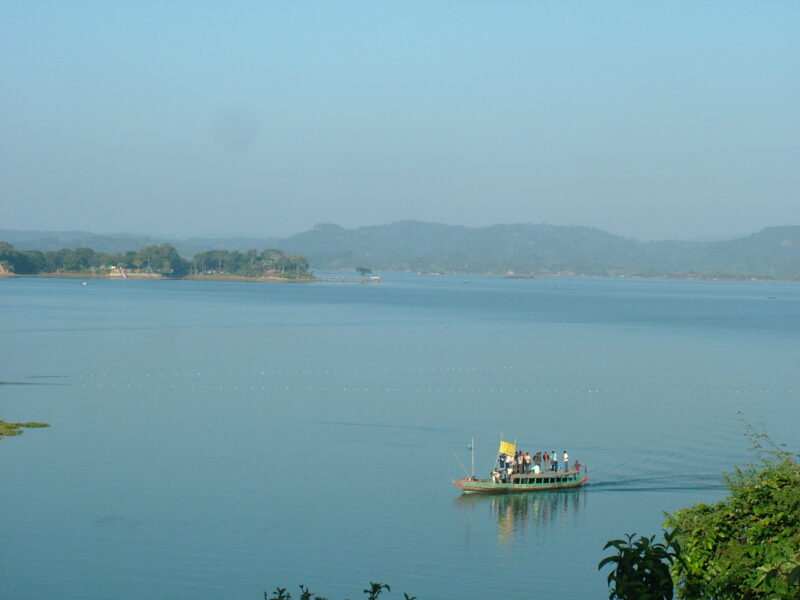 Figure 3. Kaptai Lake.
Photo: Tanim.
Creative Commons Attribution-Share Alike 3.0 Unported license (https://commons.wikimedia.org/wiki/File:Kaptai_Lake04.jpg)
The Karnaphuli matters to many people. It is vital to those living near it as well as to many others living further away: city dwellers who depend daily on its hydroelectricity, displaced citizens who had to seek refuge abroad, and all those who use the port of Chittagong. It is a river that provides a good example of the “hydrosocial cycle” by which water and society make and remake each other. To begin with, over many generations the river’s life-giving waters and aquatic organisms supported and shaped human cultures across four distinct zones.
Second, humans used the river to establish their power over other humans. It has long been a prized pathway for warfare, rule, and trade and, over the past few centuries, power shifted away from the uplands to the lowlands – and from local powerholders to more distant ones who understood the river purely as a resource to be exploited.
Third, as the power of humans over nonhumans grew, the ecosystems of the Karnaphuli suffered progressive degradation. The rising water of the dam lake destroyed uncounted animals and plants in what had been the valleys of the Karnaphuli. Human activities damaged the Karnaphuli’s aquatic habitat along its full length, but especially in its lower reaches where water pollution was most pronounced.
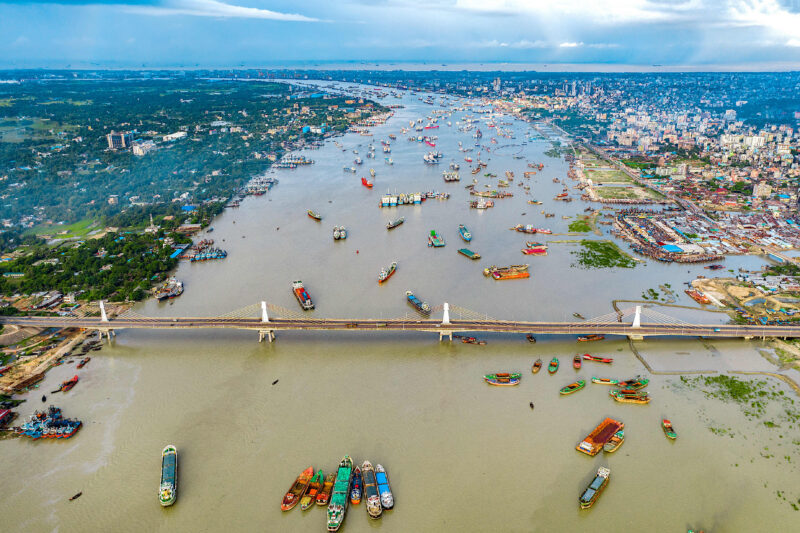
Figure 4. The Karnaphuli river passes Chittagong on its way to the Bay of Bengal, seen in the background.
Photo: Abdulmominbd.
Creative Commons Attribution-Share Alike 4.0 International license (https://commons.wikimedia.org/wiki/File:Shah_Amanat_763.jpg)
But now the hydrosocial pendulum has started swinging in the opposite direction, with the Karnaphuli remaking human society in unfamiliar ways as it becomes a growing threat to those who depend on its increasingly toxic liquid contents. The destructive impact of the river on human society is expected to increase further because global warming is widely projected to intensify rainfall in this region. This will lead to more water in the river, changes in agricultural production and flash floods. In the very long run, rising sea levels could shorten the river itself because sea water would permanently submerge the lowlands and wipe out everything that lives there. Such scenarios were unthinkable half a century ago, but they are seriously contemplated today. In the case of the Karnaphuli, human manipulation of the river is age-old, but human dominance can be said to start roughly from the mid-twentieth century. And this dominance was the domain of certain humans only, with others pondering: “whose river is it anyway?”
Perpetual “making and remaking” occurs all over our “rivered earth,” wherever fresh flowing water and humans meet. Detailed empirical case studies are key to understanding hydrosocial cycles. Comparing these cases allows us to explore “translocal” patterns – similarities that may exist between the hydrosocial dynamics of, say, all borderlands rivers and their human societies.
Reference:
van Schendel, Willem (2026) “A Monsoon River and Its Humans: The Karnaphuli in India and Bangladesh.” In Iftekhar Iqbal, Noor Hasharina Hassan and Asiyah Kumpoh (eds.) (2026) Fluid Phenomena: The River and Anthropocene Life-world in the Asia-Pacific. Leiden and Boston: Brill.
The full chapter can be downloaded here: